
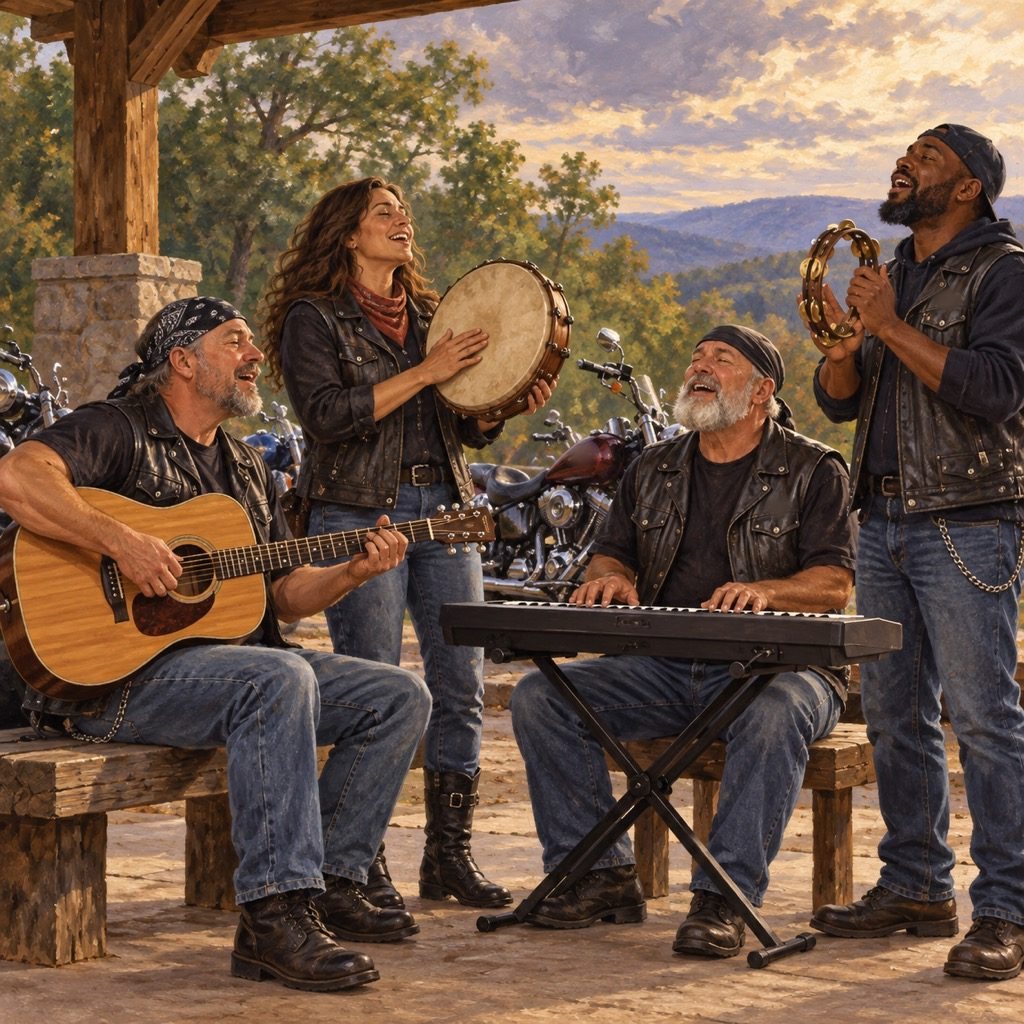
Three articles from Pastor Tom’s online pastoral newsletter, Spending Time With Jesus.
Musical instruments in the Bible and divine service
The Bible teaches that stringed instruments and percussion instruments belong in our worship services, in the house of God, because they were commanded to be used there by God Himself.
After that you shall come to the hill of God where the Philistine garrison is. And it will happen, when you have come there to the city, that you will meet a group of prophets coming down from the high place with a stringed instrument, a tambourine, a flute, and a harp before them; and they will be prophesying.
1 Samuel 10:5
Then David spoke to the leaders of the Levites to appoint their brethren to be the singers accompanied by instruments of music, stringed instruments, harps, and cymbals, by raising the voice with resounding joy. 19The singers, Heman, Asaph, and Ethan, were to sound the cymbals of bronze; 28Thus all Israel brought up the ark of the covenant of the Lord with shouting and with the sound of the horn, with trumpets and with cymbals, making music with stringed instruments and harps.
1 Chronicles 15:16, 19, 28
Asaph the chief, and next to him Zechariah, then Jeiel, Shemiramoth, Jehiel, Mattithiah, Eliab, Benaiah, and Obed-Edom: Jeiel with stringed instruments and harps, but Asaph made music with cymbals; 42and with them Heman and Jeduthun, to sound aloud with trumpets and cymbals and the musical instruments of God. Now the sons of Jeduthun were gatekeepers.
1 Chronicles 16:5, 42
Notice, he didn’t just mark the verses with the cymbals, he “made music” with them.
12and the Levites who were the singers, all those of Asaph and Heman and Jeduthun, with their sons and their brethren, stood at the east end of the altar, clothed in white linen, having cymbals, stringed instruments and harps, and with them one hundred and twenty priests sounding with trumpets; 13indeed it came to pass, when the trumpeters and singers were as one, to make one sound to be heard in praising and thanking the Lord, and when they lifted up their voice with the trumpets and cymbals and instruments of music, and praised the Lord, saying: “For He is good, For His mercy endures forever,” that the house, the house of the Lord, was filled with a cloud, 14so that the priest could not continue ministering because of the cloud; for the glory of the Lord filled the house of God.
2 Chronicles 5:12-14
This shows that God was so pleased with the cymbals and the music he’d just listened to, and his response was so glorious, that the priest couldn’t even continue to minister! God enjoyed it!
12Now when Athaliah heard the noise of the people running and praising the king, she came to the people in the temple of the Lord. 13When she looked, there was the king standing by his pillar at the entrance; and the leaders and the trumpeters were by the king. All the people of the land were rejoicing and blowing trumpets, also the singers with musical instruments, and those who led in praise. So Athaliah tore her clothes and said, “Treason! Treason!”
2 Chronicles 23:12, 13
20And the Lord listened to Hezekiah and healed the people. 21So the children of Israel who were present at Jerusalem kept the Feast of Unleavened Bread seven days with great gladness; and the Levites and the priests praised the Lord day by day, singing to the Lord, accompanied by loud instruments. 23Then the whole assembly agreed to keep the feast another seven days, and they kept it another seven days with gladness.
2 Chronicles 30:20-21, 23
27Now at the dedication of the wall of Jerusalem they sought out the Levites in all their places, to bring them to Jerusalem to celebrate the dedication with gladness, both with thanksgivings and singing, with cymbals and stringed instruments and harps. 42also Maaseiah, Shemaiah, Eleazar, Uzzi, Jehohanan, Malchijah, Elam, and Ezer. The singers sang loudly with Jezrahiah the director. 43Also that day they offered great sacrifices, and rejoiced, for God had made them rejoice with great joy; the women and the children also rejoiced, so that the joy of Jerusalem was heard afar off.
Nehemiah 12:27, 42, 43
The use of percussion instruments in the divine worship service
Critiques of the newer praise music often make the mistake of comparing the “Sanctuary Service” of the priests in the holy and most holy place with the church service of today. The people never entered the holy or most holy place. You cannot compare our present-day church service to the holy or most holy. That’s comparing apples and oranges. The Sanctuary in heaven is apples to apples, when compared to the earthly sanctuary of the Old Testament.
The "house of God" is not an earthly sanctuary in the OT sense. Oranges to oranges would be to compare our church and the people’s court. That is where the worship services were held. The people were allowed in the outer courts and that is where they would gather, also they would surround the sanctuary. That is where the “assembly” of the people would sing the Psalms of David. Leviticus indicates that women were allowed in the sanctuary except when they were unclean for a prescribed number of days (Leviticus 12:4). This was the outer area, not the holy of holies.
In Drums, Rock, and Worship, on page 44, the author writes: “Notice that the drum is used on festive occasions and never in connection with the divine service or worship. They also were systematically excluded from the Jerusalem Temple.”
This is simply a quote from another prominent contemporary music critic. Both of them are wrong in what they are saying. There is no scripture or EGW quote that says anything like that. They are trying to impose their opinions on us without any scriptural basis.
Notice the Bible specifically states that cymbals, a percussion instrument, was used “in the house of the Lord,” and “in the SERVICE of the house of the Lord”. Stringed instruments like the guitar and piano, and cymbals are usable in the service of God's house.
Moreover David and the captains of the army separated for the service some of the sons of Asaph, of Heman, and of Jeduthun, who should prophesy with harps, stringed instruments, and cymbals. And the number of the skilled men performing their service was: 3Of Jeduthun… who prophesied with a harp to give thanks and to praise the Lord. 6All these were under the direction of their father for the music in the house of the Lord, with cymbals, stringed instruments, and harps, for the service of the house of God. Asaph, Jeduthun, and Heman were under the authority of the king.
1 Chronicles 25:1, 3, 6
Notice the cymbals were “for the music in the house of the Lord, with cymbals, stringed instruments, and harps, for the service of the house of God.” It’s as if God was making sure we all would get it. Not just IN the house of the Lord, but in the SERVICE of the house of God. Can there be any doubt that God is pleased, when the instruments he commanded are used in the service of his house? There was nothing wrong with using them then, and there is nothing wrong with using them correctly now.
25And he stationed the Levites in the house of the Lord with cymbals, with stringed instruments, and with harps, according to the commandment of David, of Gad the king’s seer, and of Nathan the prophet; for thus was the commandment of the Lord by his prophets. 26The Levites stood with the instruments of David, and the priests with the trumpets. 27Then Hezekiah commanded them to offer the burnt offering on the altar. And when the burnt offering began, the song of the Lord also began, with the trumpets and with the instruments of David king of Israel. 30So they sang praises with gladness, and they bowed their heads and worshiped.
2 Chronicles 29:25-27, 30
Also, it is clear that these instruments were used to preach, or prophesy with, and they were used in connection with the sanctuary. This text shows that when the priest, in the sanctuary service offered the burnt offering, the song of the Lord was played, according to God's commandment, accompanied by cymbals, in the sanctuary.
There is nothing wrong with using instruments God commanded to be used, in the way God allowed. If you can hit a cymbal once, you can hit it 100 times. They need to be played properly, but there is nothing wrong with using them in the house of God. That’s why in 2 Chronicles 5:14 it says God’s glory filled the house of the Lord, with such brilliance that the priests had to leave. God obviously approved of the cymbals they used!
The timbrel was also used in the Sanctuary to praise God.
24They have seen Your procession, O God,
Psalm 68:24, 25
The procession of my God, my King, into the sanctuary.
25The singers went before, the players on instruments followed after;
Among them were the maidens playing timbrels.
The timbrel was played in the sanctuary according to this text. Women entered the sanctuary, and played timbrels. It wasn’t just “paid” musicians as some suggest. In the New Testament, there is no earthly priesthood. We now believe in the priesthood of all believers. Music ministry is open to any musician elected by the church to serve. If timbrels can be used once, they can be used 100 times. It is not an evil instrument. It is the way it is played that is important.
Notice in the Psalms, which were written for public worship in the house of God, AND IN THE ASSEMBLY OF THE SAINTS, we are commanded to praise him in the Sanctuary on the timbrel, and the loud and clashing cymbals. We are even instructed to Let the children of Zion be joyful and to let them praise him on the timbrel and the harp.
Praise the Lord!
Psalm 150:1-6
1Praise God in His sanctuary;
Praise Him in His mighty firmament!
2Praise Him for His mighty acts;
Praise Him according to His excellent greatness!
3Praise Him with the sound of the trumpet;
Praise Him with the lute and harp!
4Praise Him with the timbrel and dance;
Praise Him with stringed instruments and flutes!
5Praise Him with loud cymbals;
Praise Him with clashing cymbals!
6Let everything that has breath praise the Lord.
Praise the Lord!
Praise the Lord!
Psalm 149:1-3
1Sing to the Lord a new song,
And His praise in the assembly of saints.
2Let Israel rejoice in their Maker;
Let the children of Zion be joyful in their King.
3Let them praise His name with the dance;
Let them sing praises to Him with the timbrel and harp.
We cannot forbid that which the Bible does not forbid, nor condemn that which the Bible does not condemn. Opponents of the worshipful music played today by our young people need to heed these bible verses, and stop their “guilt by association” smear tactics of condemnation. All new music is not “rock,” and a “trap set” is just a grouping of cymbals and “timbrels”, Biblical musical instruments and can be used to glorify God or not, depending on the way it's played.
To say they can be played separately, but not grouped together to make it easier to play is ridiculous. One timbrel or ten, they are approved of, as long as they are played properly. A drum is a timbrel. They are both round pieces of wood with a goatskin stretched across the top. Timbrels are often referred to as “hand drums”.
It is sad some have to use the filth of the world in their books, and try to transfer the muck they have raked up to modern Christian music. Some is worldly, and should not be used in worship. However, much of it is very uplifting. We need to learn to be discriminating in what music we listen to, and not just condemn anything that’s new. We can use music for a variety of purposes. Some music we listen to on the treadmill, jogging five miles, would not be appropriate for worship services and vice versa. We need to have a mature attitude about these cultural issues. Christian freedom, in the gospel of Jesus Christ, gives us the power of choice, and our musical taste can be diverse. People are moved in different ways by different music. You don’t need to be a scholar to interpret these texts. Ellen White instructs us to let the Bible interpret itself, by using the simple and most obvious meaning. Anyone can understand the text’s meaning. Opponents often use a multitude of words to try to get around, and explain away the straightforward meaning of these texts. Don’t fall for their tactics. Some are great lawyers, who can argue forever about semantics, and language. But when you read these texts prayerfully, you can hear God’s voice speaking. A multitude of words does not lessen the power of one “Thus saith the Lord”! We are free to use any of these instruments in a responsible way.
To the modern church of Israel, the assembly of His saints, God says:
1Sing to the Lord a new song,
Psalm 149:1-3
And His praise in the assembly of the saints,
2Let Israel rejoice in their Maker;
Let the children of Zion be joyful in their King.
3...Let them sing praises to Him with the timbrel and harp.
These Bible verses demonstrate that percussion instruments were often used in Jewish worship, both outside the temple, and in the house of God, in His temple and in the very sanctuary of God. Contrary to what some teach, women played a vital part in that worship. The sheer number of references to these instruments in the Bible shows that it was God’s intention that they be used in his worship services. They were “commanded by the Lord” and his prophets. These instruments were used in the very sanctuary of God, and in the assembly of the people, to bring power and life to their music. This is shown by the references to loud and clashing cymbals. Exuberant praise and worship was something God had no problem enjoying from his people. He commanded it.
Sing a new song, rejoice, be joyful, and praise him upon the drum and the harp, IN THE ASSEMBLY OF THE SAINTS!
Not with bedlam, not with noise, not with a din of confusion, but played in an uplifting, proper manner. Music that adds to the message, and does not take away from it. Instruments to enhance the music, rather than to dominate it. We should not condemn the use of these instruments or “sing tracks” just because there is a cymbal or drum in the background, adding to the power and movement of the song. Can music be done properly? Of course it can. Is it hard for people to change and adjust to new ways? Of course it is. After all, “In the Garden” and “How Great Thou Art” were new songs once! Some of the new worship music will be looked at in the same way by the young generation, years from now.
May God bless us as we learn to grow and mature as a church, using our freedom of choice in a responsible way, and not let fear and ignorance keep us from being supportive and understanding of one another. May modern Israel “let the Children” be joyful in their King, and let them sing praises to Him with the cymbal, timbrel, stringed instruments and harp is my prayer in Jesus’ name. Amen!
The Spirit of Prophecy’s most famous music quote
Ellen White has much to say about music in her writings. Most of what she has said has been quoted extensively. However, it has always been implied that she would be against shouting, and percussion instruments because of the most widely quoted statements found in 2 Selected Messages pp. 26-38. Compilations often reflect the opinions of those who do the compiling. The titles and emphasis can be used to characterize something in a negative way. So let’s look at this quote, and see if it isn’t saying more than the usually emphasized portions would suggest. Here is the quote:
Worship with a bedlam of noise
It is impossible to estimate too largely the work that the Lord will accomplish through His proposed vessels in carrying out His mind and purpose. The things you have described as taking place in Indiana, the Lord has shown me would take place just before the close of probation. Every uncouth thing will be demonstrated. There will be shouting, with drums, music, and dancing. The senses of rational beings will become so confused that they cannot be trusted to make right decisions. And this is called the moving of the Holy Spirit
Selected Messages, book 2, p. 36
The Holy Spirit never reveals itself in such methods, in such a bedlam of noise. This is an invention of Satan to cover up his ingenious methods for making of none effect the pure, sincere, elevating, ennobling, sanctifying truth for this time. Better never have the worship of God blended with music than to use musical instruments to do the work which last January was represented to me would be brought into our camp meetings. The truth for this time needs nothing of this kind in its work of converting souls. A bedlam of noise shocks the senses and perverts that which if conducted aright might be a blessing. The powers of satanic agencies blend with the din and noise, to have a carnival, and this is termed the Holy Spirit's working.
No encouragement should be given to this kind of worship. The same kind of influence came in after the passing of the time in 1844. The same kind of representations were made. Men became excited, and were worked by a power thought to be the power of God
Selected Messages, book 2, p. 37
History of the past to be repeated
I will not go into all the painful history; it is too much. But last January the Lord showed me that erroneous theories and methods would be brought into our camp meetings, and that the history of the past would be repeated. I felt greatly distressed. I was instructed to say that at these demonstrations demons in the form of men are present, working with all the ingenuity that Satan can employ to make the truth disgusting to sensible people; that the enemy was trying to arrange matters so that the camp meetings, which have been the means of bringing the truth of the third angel's message before multitudes, should lose their force and influence
Selected Messages, book 2, p. 37
The third angel's message is to be given in straight lines. It is to be kept free from every thread of the cheap, miserable inventions of men's theories, prepared by the father of lies, and disguised as was the brilliant serpent used by Satan as a medium of deceiving our first parents. Thus Satan tries to put his stamp upon the work God would have stand forth in purity
Selected Messages, book 2, p. 37
The Holy Spirit has nothing to do with such a confusion of noise and multitude of sounds as passed before me last January. Satan works amid the din and confusion of such music, which, properly conducted, would be a praise and glory to God. He makes its effect like the poison sting of the serpent.
Selected Messages, book 2, p. 37
Those things which have been in the past will be in the future. Satan will make music a snare by the way in which it is conducted. God calls upon His people, who have the light before them in the Word and in the Testimonies, to read and consider, and to take heed
Selected Messages, book 2, p. 38
Now let’s study the meaning of this passage. What is she condemning in this passage? Is it the instruments that were used, or how the instruments were played? She is not condemning any musical instrument. She is condemning the irresponsible use of these instruments to create bedlam and noise. Notice these words: “uncouth, bedlam of noise, cheap, miserable inventions, confusion of noise, and multitude of sounds, din, shocks the senses, confusion, and a snare.”
The music she heard that January was absolute bedlam, and would be inappropriate for use in any of God’s services. But notice what she did not say. She did not say the drums were bedlam, she said the music created on them at that meeting was bedlam. This is indicated because she says, “A bedlam of noise shocks the senses and perverts that which if conducted aright might be a blessing.” She is talking about the instruments she mentioned, and the way the music was created. If the drums are played “aright”, they can be a blessing, according to her.
She continues: “Satan works amid the din and confusion of such music, which, properly conducted, would be a praise and glory to God.”
Here she says that if the instruments that are creating the din and confusion were properly conducted they would be a praise and glory to God.
Again she says, “Satan will make music a snare by the way in which it is conducted.” Contemporary Christian music that falls into the category of “uncouth, bedlam of noise, cheap, miserable inventions, confusion of noise, and multitude of sounds, din, shocks the senses, confusion, and a snare” should never be introduced into our services. Having said that, the critics of modern worship music rarely draw much distinction between the different types of music found in our churches. They usually just condemn all music containing any use of percussion instruments with a very broad brush. What I am advocating is a more mature approach to the issue of contemporary music of any kind. All music categories are artificial and arbitrary. There is no “Christian” music; only the lyrics make a song “Christian”. Without lyrics, there is no way to tell whether it is Christian or not. We need to be open to using biblical instruments in a proper and dignified way, and not try to forbid what God does not. We should agree to only use music that does not fall into the negative category described, but not to forbid Contemporary Christian music that is conducted “aright”. The use of cymbals or drums does not make it unfit for worship. It is only when they are played in an improper manner that they are noisy din. The instrument can be used to create chaos or to glorify God. It is all in the manner in which it is used. So it is clear from this passage that we are not forbidden to use percussion instruments, if we conduct them “aright”. It is my prayer that we will be tolerant of others, and careful to not allow the proper use of drums to dominate the music, or give the music a sensuous or shocking quality. People on both sides of this issue must pray much, and not allow the demagogues to market fear and mistrust of one another. We can study the Bible and the Spirit of Prophecy, and come to some reasonable sound conclusions.
Exuberant worship and praise
Therefore I desire that the men pray everywhere, lifting up holy hands, without wrath and doubting.
1 Timothy 2:8
“God is holy, and we must pray, ‘lifting up holy hands without wrath or doubting.’”
In Heavenly Places, p. 71
Oh, clap your hands, all you peoples! Shout to God with the voice of triumph... Sing praises to God, sing praises! Sing praises to our King, sing praises!
Psalm 47:1, 2
Ps. 63:4 says in the sanctuary we are to “lift up my hands in your name... my mouth shall praise you with joyful lips.” Psalm 66:1: “Make a joyful shout to God all the earth!” Psalm 98:1: “Oh, sing to the Lord a new song! 4Shout joyfully to the Lord all the earth, break forth in song, rejoice, and sing praises. 5Sing to the Lord with the harp, and the sound of a psalm. 6With trumpets and the sound of a horn; Shout joyfully before the Lord, the King.” See also Psalm 100:1. Psalm 147 is all about praise, how good and pleasant it is, to praise him on the harp, etc. as is Psalm 148, and Psalm 149 tells us to praise him with the dance, the tambourine, and harp, “in the assembly of the saints.” Psalm 150 says to praise him in his SANCTUARY with the trumpet, lute, harp, tambourine, dance, stringed instruments, flutes, loud cymbals, and high cymbals, finally saying that everything that has breath should praise the Lord.
Note the following Ellen G. White quotes:
“As Christians we ought to praise God more than we do.... The melody of praise is the atmosphere of heaven: Let there be singing in the home of songs that are sweet and pure, fewer words of censure and more of cheerfulness and hope and joy.... catch the themes of praise and thanksgiving from the heavenly choir round about the throne. What joy the angels would look down from heaven upon us if we were ALL PRAISING GOD....begin to sing the song of praise and rejoicing here below...Let your LIPS be tuned to praise God...Angels in heaven are praising God ALL THE TIME and mortals offer no song of praise...If you sit in heavenly places with Christ, you cannot refrain from praising God. Begin to educate YOUR TONGUES TO PRAISE HIM and TRAIN your hearts to make melody to God; and when the evil one begins to settle his gloom about you sing praise to God.... Satan will leave you...We need to offer praise and thanksgiving to God, not only in the congregation but in the home...We need to PRAISE GOD MUCH MORE THAN WE DO. WE ARE TO SHOW THAT WE HAVE CAUSE FOR REJOICING....By our failure to express gratitude we are dishonoring our maker... Make a joyful shout to the Lord all you lands.”
See Patriarchs and Prophets, pp. 94-96, and other passages
“Sunday the power of God came upon us like a mighty rushing wind. All arose upon their feet and praised God with a loud voice; it was something as it was when the foundation of the house of God was laid. The voice of weeping could not be told from the voice of shouting. It was a triumphant time; all were strengthened and refreshed. I never witnessed such a powerful time before”
Letter 28, 1850 (to the church in Brother Hastings’ home, November 7, 1850); Manuscript Releases, vol. 5, p. 226
“Our last conference was one of deep interest. Two were dug from beneath the rubbish. The present truth was presented in its clear light and it found way to the hearts of the erring. Before the meeting closed all were upon their knees, some were crying for mercy that had been cold-hearted and indifferent, others were begging for a closer walk with God and for salvation. It was as powerful a time as I ever witnessed; the slaying power of God was in our midst. Shouts of victory filled the dwelling. The saints here seem to be rising and growing in grace and knowledge of the truth”
Letter 30, 1850 (to Brother and Sister Loveland, December 13, 1850); Manuscript Releases, vol. 5, p. 226
“Singing, I saw, often drove away the enemy and shouting would beat him back. I saw that pride had crept in among you, and there was not childlike simplicity among you. The fear of man, I saw, must all go”
Manuscript 5a, 1850 (“To the Church in Your Place,” July 1850); Manuscript Releases, vol. 5, p. 238
“I saw we must be daily rising and [must] keep the ascendancy above the powers of darkness. Our God is mighty. I saw singing to the glory of God often drove the enemy, and praising God would beat him back and give us the victory. I saw that there was too little glorifying God, too little childlike simplicity among the remnant”
Manuscript 5, 1850 (“A Vision the Lord Gave Me at Oswego,” July 29, 1850); Manuscript Releases, vol. 5, p. 238
“The glory of the Lord shone about us, and we all rejoiced and triumphed in God for His unbounded goodness to us. All in the room were blest and shouted the praise of God”
Letter 9, 1853 (to Sister Kellogg, December 5, 1853); Manuscript Releases, vol. 5, p. 240
“Father's face was lighted up with the glory of God. Sister Ings felt His power as never before. We all shouted the praise of God. It was weeping for joy and blessing of God with gladness of heart. Everyone in the room was blessed.”
Manuscript Releases, vol. 5, p. 241
“We returned to rest, but we could not sleep. We were too happy for sleep. We praised our Saviour nearly all night. There was not much sleeping done in the house that night. God had come with His holy presence into the house, and His sanctifying presence was too highly prized to sleep over the hours to us so precious. We have been very happy ever since. Peace and joy have flowed in upon our souls like a river. There has been uninterrupted peace and rest in the dear Saviour. Such an assurance as we are having is worth more than riches or gold, honor or worldly glory. I prize it! I prize it! The praise of God has been in our hearts, and upon our lips continually since that good evening. My peace is like a river and the righteousness thereof like the waves of the sea.”
Letter 11, 1877 (to “Dear Children,” August 31, 1877); Manuscript Releases, vol. 5, p. 242
Therefore by Him let us continually offer the sacrifice of praise to God, that is, the fruit of our lips, giving thanks to His name.
Hebrews 13:15
Isn't it interesting that sometimes we can push Satan back, and obtain the victory by “shouting praise to God”? Are you ready to do that? To not just sit quietly, “thinking” your praise, but to shout it out loud, with all the passion you possess? My conviction is that we have lost our first love. Praise and worship can revive our first love, and give us strength to overcome. These quotes impress me with the necessity of praising God all the time, softly and loudly, in church and at home, everywhere! Let us exalt the God of heaven and praise his Holy name! Let’s love one another in a spirit of tolerance and understanding. We are all different in our way of worship. Let’s dwell on our precious Savior who has “set us free” to worship him in spirit and in truth.
God Bless you as you study these issues in the Word of God.
Pastor Tom Hughes